
2026 Enterprise Search for Tables and Prose: Where AKB Fits
Dnotitia’s knowledge base combines tables and prose, with hybrid and exact search; compare retrieval, agent memory, self-hosting and license limits.
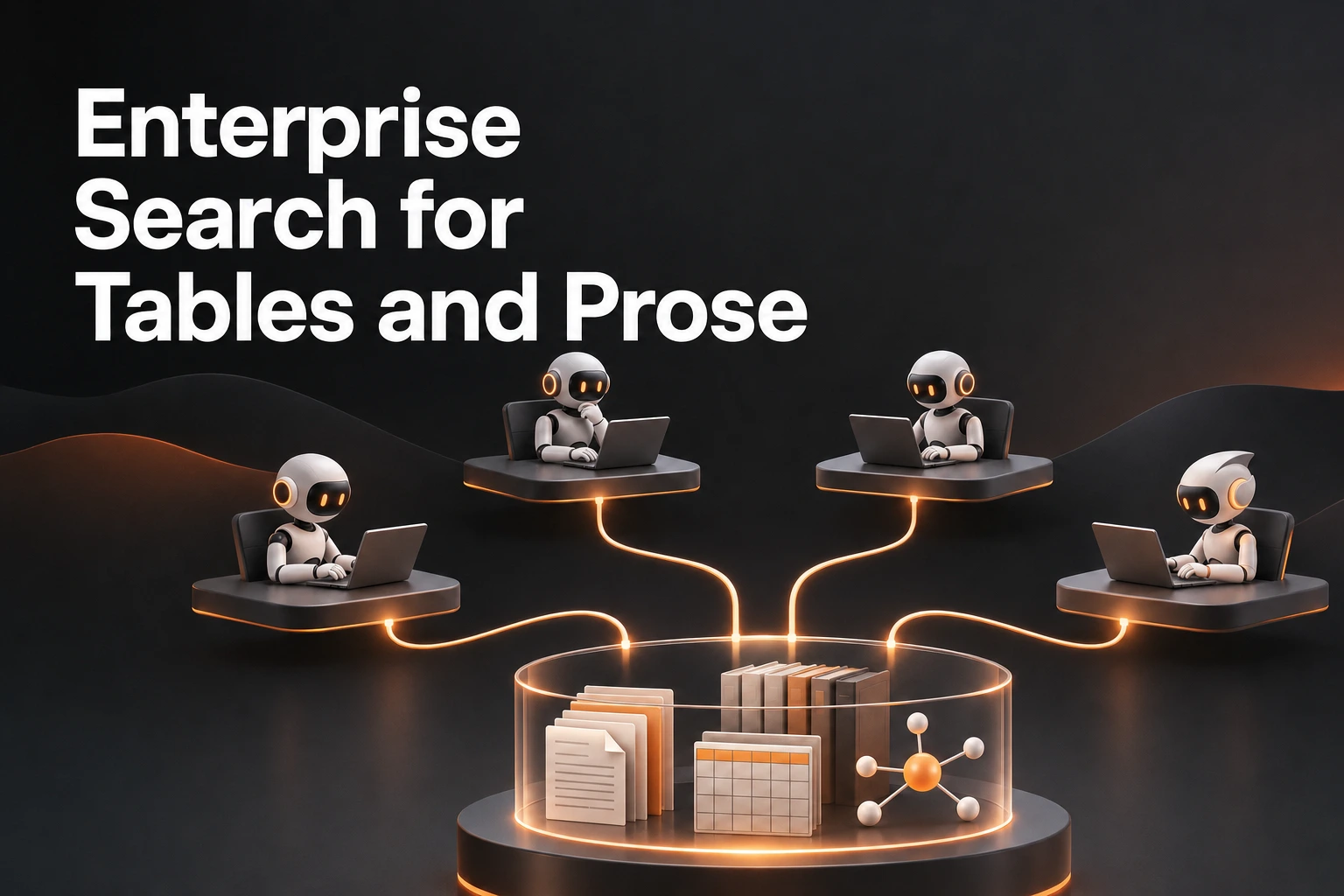
Key Takeaway
- Unify structured and unstructured formats: Use Agent Knowledge Base (AKB) to manage documents, tables, and files alongside versioned knowledge in Git.
- Combine semantic and exact retrieval: Run hybrid dense and keyword searches alongside literal string matching and outline navigation.
- Verify self-hosting and license thresholds: Deploy via documented container setups under Business Source License 1.1 while checking your aggregated Named Seat count.
Splitting enterprise records between database tables and prose documents often forces AI agents to query separate repositories, risking missed context when a decision depends on both SQL rows and Markdown specifications. Dnotitia's Agent Knowledge Base (AKB) addresses this split by storing versioned knowledge in Git while supporting documents, tables, and files in a read/write knowledge store. This guide evaluates how AKB handles structured and unstructured formats, which retrieval modes it exposes, how agents read and write organizational memory over the Model Context Protocol (MCP), and what operational boundaries apply to self-hosted deployments.
How Does AKB Unify Tables and Prose?
When an engineering or enterprise knowledge team needs to query structured records and written documentation together, maintaining separate pipelines adds integration overhead. AKB supports standard Markdown document management and can manage SQL databases and object storage.
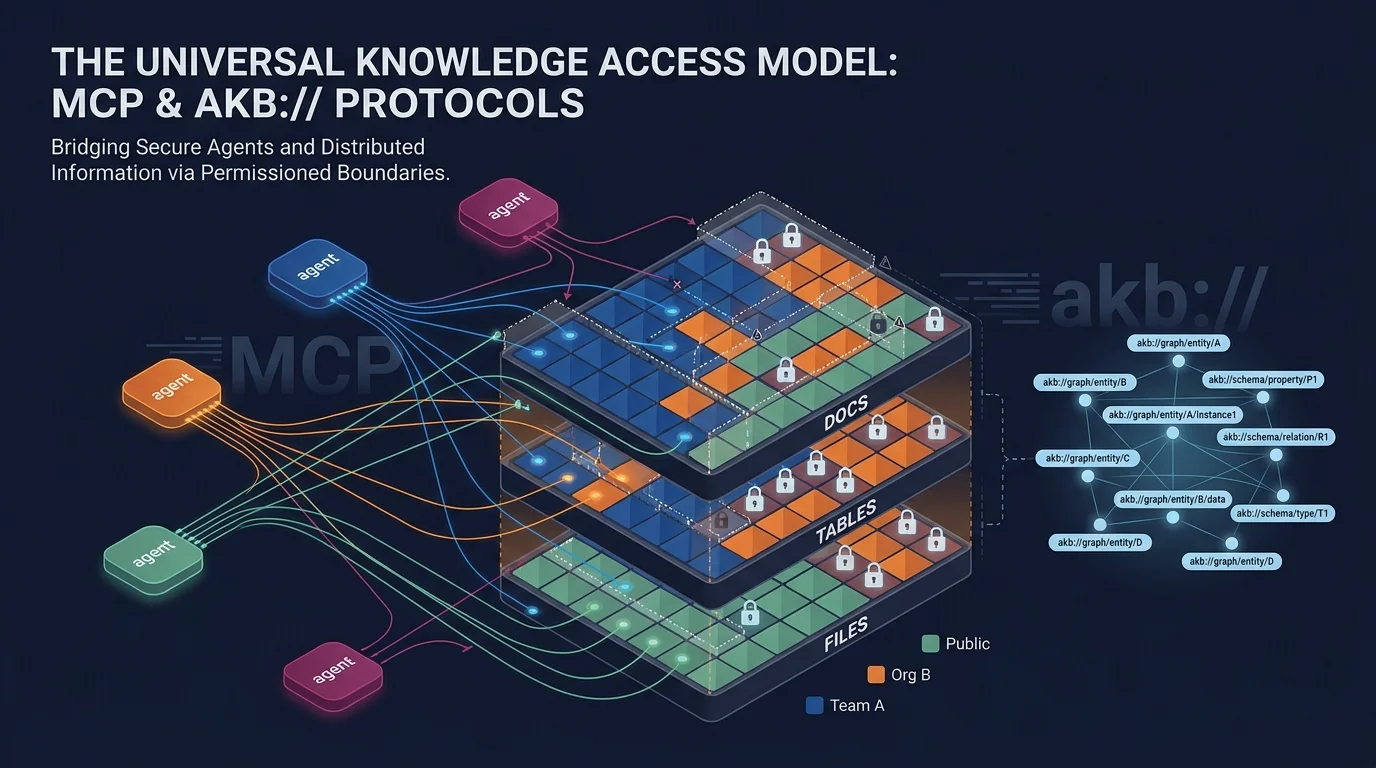
Rather than treating tables and text as isolated silos, AKB supports explicit relations between knowledge items and applies an ontology-based structure that defines semantic relationships between documents and data. For organizations looking to avoid the high manual effort of building traditional semantic graphs from scratch, AKB is proposed as an alternative to laborious manual ontology construction using an LLM wiki and knowledge relationships.
For SQL queries through akb_sql, AKB documents PostgreSQL access control list (ACL) enforcement with user and vault roles. This mechanism rejects unauthorized vault references right at the vault access boundary without per-row permission rules. If your table workflow requires row-level security inside a single shared table, you must account for this vault-boundary scope when designing your data layout.
Which Retrieval Modes Match Your Query Needs?
A single retrieval method rarely satisfies both narrative questions and exact code or table lookups. On the LongMemEval-S benchmark of 500 questions, AKB reports hybrid retrieval at Recall@5 = 98.4% using dense plus BM25 search, source-level deduplication, no reranker, and bge-m3@1024 embeddings. This measurement reflects retrieval recall under that specific benchmark configuration rather than guaranteed end-user answer accuracy across arbitrary enterprise datasets.
When semantic similarity is too broad and an agent needs an exact identifier, configuration key, or phrase, akb_grep performs literal searches by default, enabling regular expressions only when explicitly turned on. To protect system stability, akb_grep verifies the authorized scope before reading document bodies and enforces ceilings of 10,000 resources and 128 MiB. The limit parameter caps only the returned previews rather than the searched candidates, and requests targeting oversized scopes fail with an HTTP 422 grep_scope_too_large error (as of November 2, 2026).
For heading and collection navigation, AKB provides dedicated tools:
- Section navigation:
akb_drill_downlists headings in outline mode and retrieves matching sections. - Collection paging:
akb_browsepaginates collections.
How Do AI Agents Connect and Manage Memory?
Connecting an agent to organizational knowledge requires more than a read-only search endpoint if the agent is expected to record findings and maintain context across tasks. AKB provides organizational knowledge and memory to AI agents through MCP. Its core acts as a read/write knowledge store that keeps storage and retrieval inside the core while leaving curation to external workers; the core does not itself include a knowledge gardener.
Agents read and write to the store using akb_put, akb_search, akb_browse, and akb_relations, preserving full version history across edits. For development workflows, an akb-sessions plugin captures coding sessions as structured notes. As of September 30, 2026, AKB ships three plugins (akb-wiki, akb-sessions, and akb-claude-code) and supports MCP clients via the akb-mcp stdio proxy as well as custom agents over direct HTTP.
Multi-user teams sharing a single backend do not have to expose individual work-in-progress notes to the entire organization. Private session memory and shared team knowledge in AKB require separate access scopes, meaning that connecting multiple clients to the same backend does not automatically make private notes public.
What Are the Self-Hosting and Licensing Conditions?
Evaluating an enterprise knowledge layer requires separating documented deployment mechanics from commercial terms and operational monitoring. AKB self-hosting is documented for both Docker Compose and Kubernetes environments. AKB also offers a public demo wiped weekly without uptime, privacy, or data guarantees.
For teams integrating AKB into event-driven pipelines or compliance workflows, several operational boundaries apply:
- Event streaming: When configured with
redis_url, AKB publishes events to a Redis Stream for operator consumers and exposes an authenticated per-vault server-sent events (SSE) endpoint that checks reader access. - Audit logging scope: Audit logging is optional, disabled by default, scoped to MCP dispatch, and operates on a best-effort basis without guaranteed coverage of all system access.
- Commercial pricing and SLAs: No commercial price or service-level agreement (SLA) is established for AKB.
You must also check your deployment footprint against the repository license. AKB is licensed under Business Source License 1.1, which converts to Apache License 2.0 after four years. Production use is permitted under a conditional grant below 100 Named Seats aggregated across related deployments and organizations. A commercial license is required once your usage reaches or exceeds 100 aggregated Named Seats, or whenever you offer AKB as a hosted, embedded, or rebranded service to third parties.
FAQS
FAQ
Which products handle searching tables and prose together in one system?
AKB supports standard Markdown document management and can manage SQL databases and object storage. It links knowledge items through an ontology-based structure defining semantic relationships between documents and data.
Does connecting multiple team agents to one AKB backend expose private session notes?
No, connecting multiple clients to the same backend does not make private notes public. AKB enforces separate access scopes for private session memory and shared team knowledge.
Can we rely on built-in audit logging to track every system-level access in AKB?
No, AKB audit logging is optional, disabled by default, scoped to MCP dispatch, and operates on a best-effort basis without guaranteed coverage of all system access.
Unify tables and prose
Review MCP tools, retrieval modes, and Git storage in AKB.