
2026 Guide to Choosing a Knowledge Base for Code, Logs, and Prose
Technical workflows rarely keep context in a single format.
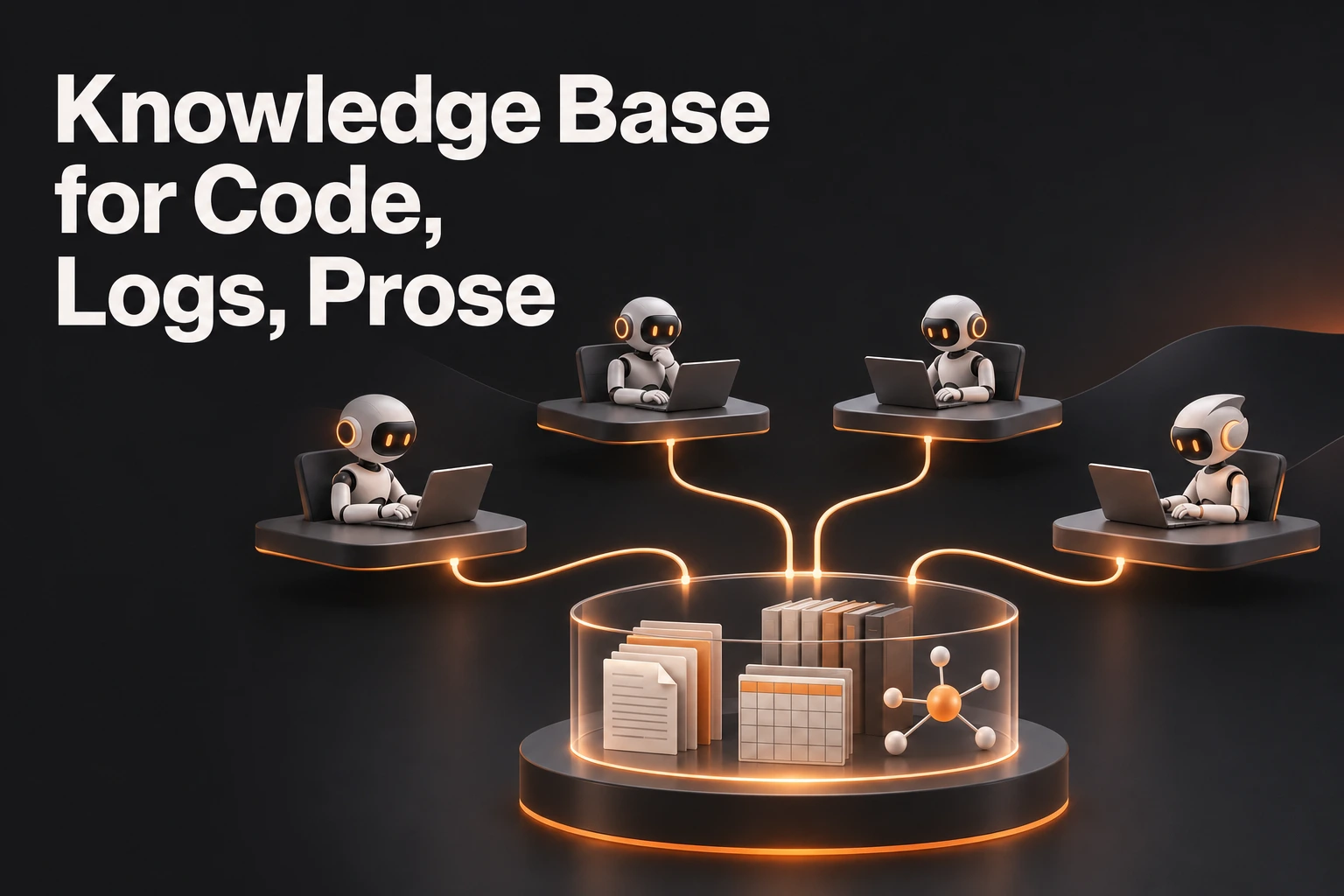
Key Takeaway
- Unify mixed technical artifacts: Store documents, files, tables, logs, and conversations under one Git-versioned, permissioned root, with a single
akb://address scheme for documents, tables, and files. - Combine semantic and literal retrieval: Use hybrid semantic and keyword search alongside literal matching and regular expressions only when explicitly enabled to query mixed content and follow explicit document relations.
- Capture coding context over MCP: Turn coding sessions into structured notes via agent plugins and connect development clients or custom agents through the Model Context Protocol.
Technical workflows rarely keep context in a single format. When you debug a production incident or build a feature, the relevant details are scattered across Markdown documentation, raw files, database tables, system logs, and prior coding conversations. Evaluating AKB (Agent Knowledge Base) for your development workflow or enterprise team comes down to whether the store places documents, files, tables, logs, and conversations under one Git-versioned, permissioned root where agents can read and write them directly over the Model Context Protocol (MCP).
What knowledge forms fit in one store?
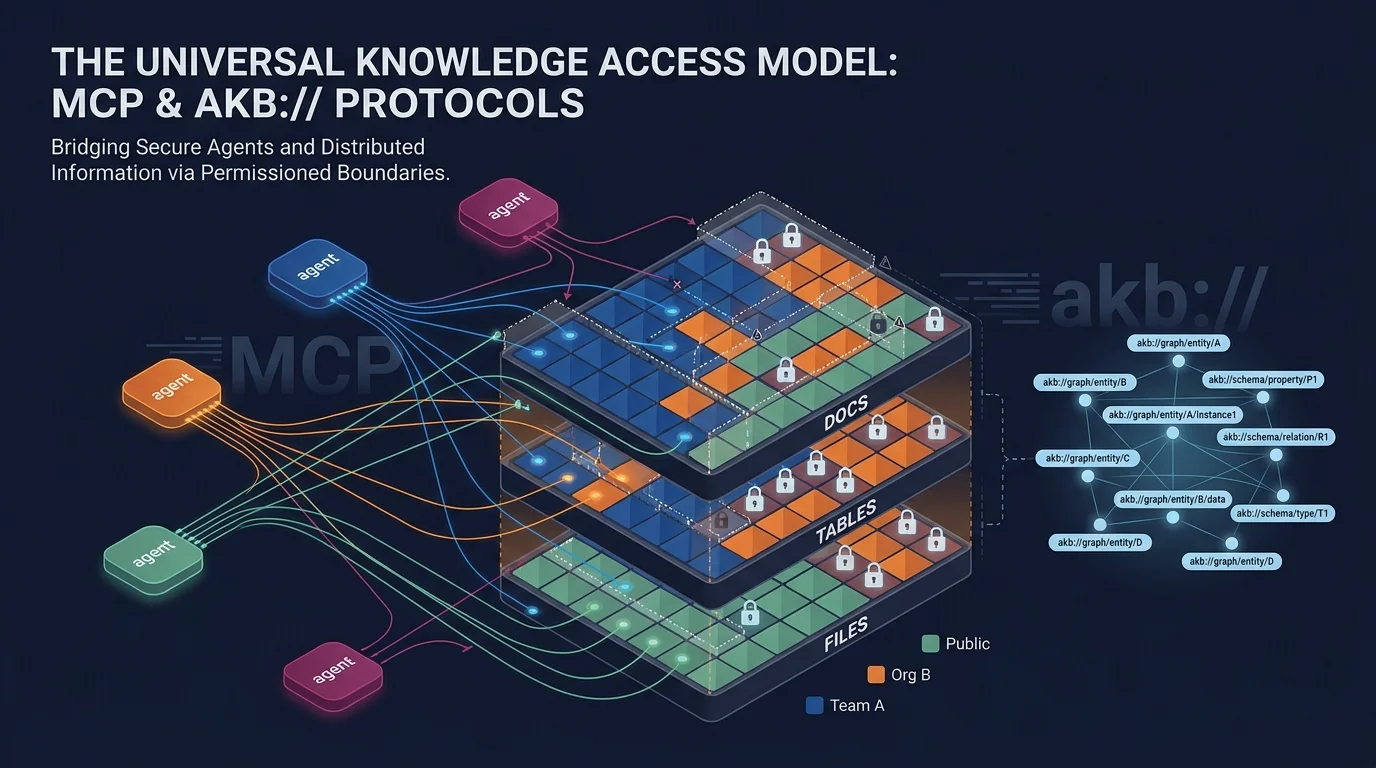
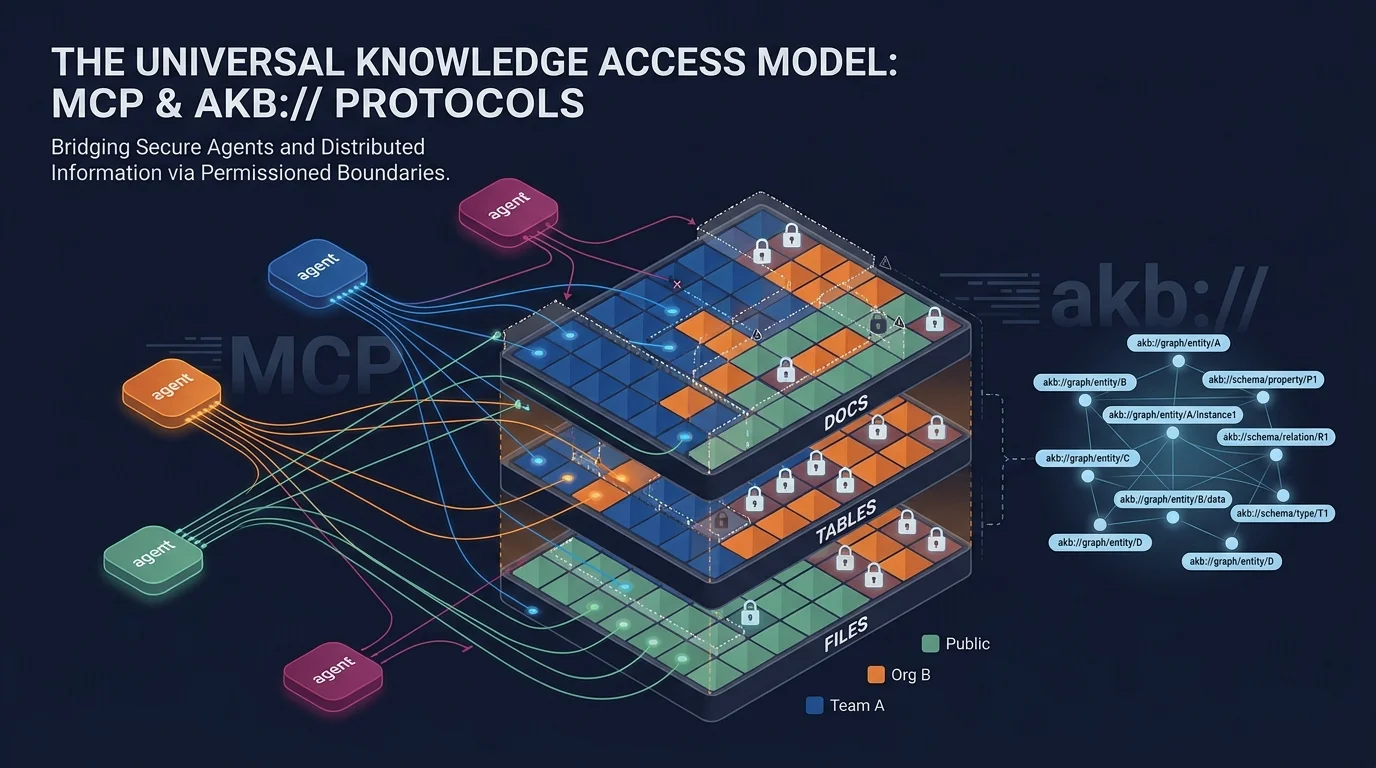
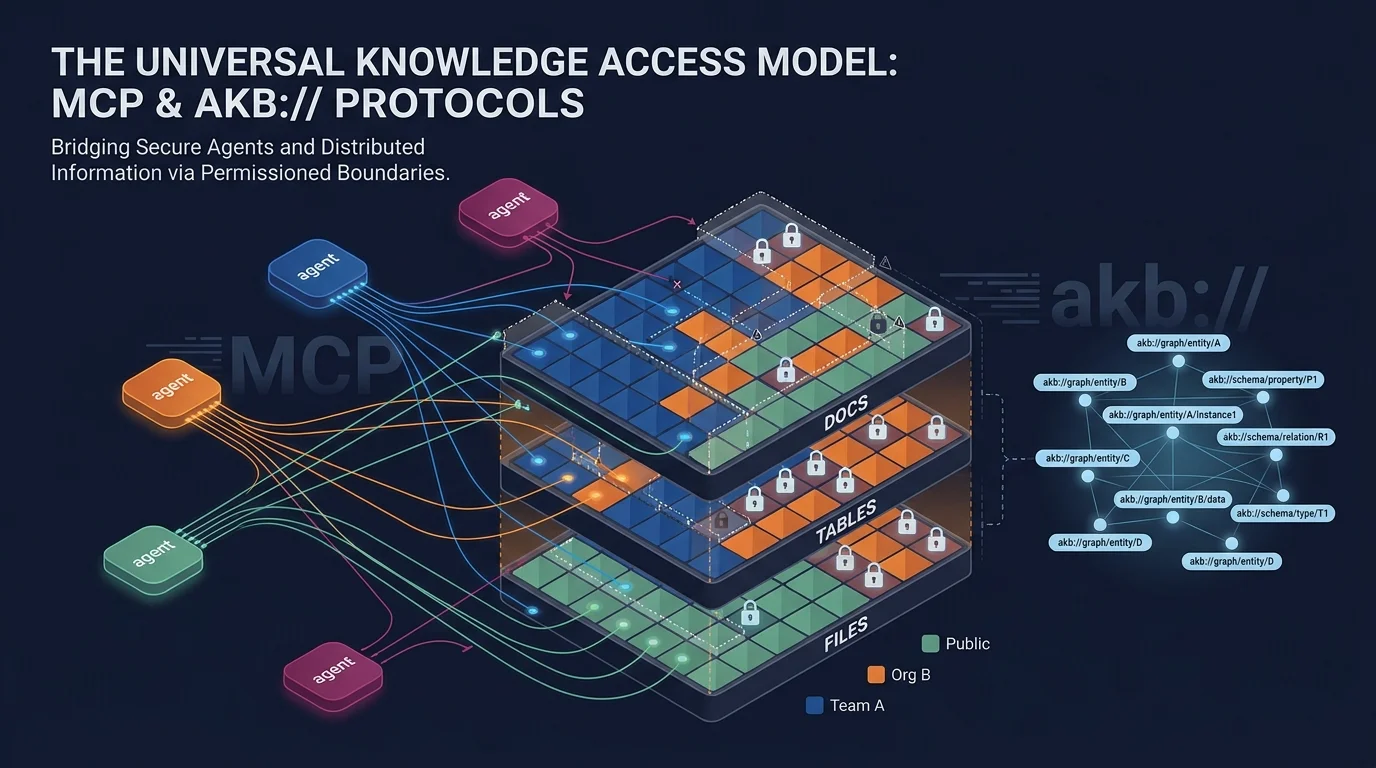
Engineering knowledge breaks apart when prose lives in a wiki, structured parameters sit in a database, and execution logs stay in separate files. AKB places documents, files, tables, logs, and conversations under a single Git-versioned, permissioned root where agents can read and write directly over MCP. You and your agents reference documents, tables, and files through one akb:// address scheme.
Under the hood, the system supports standard Markdown document management while also managing SQL databases and object storage. Every document is committed to Git, which lets you return to any point in time.
For teams organizing complex domain knowledge, AKB is proposed as an alternative to manual ontology construction by utilizing an LLM wiki and explicit knowledge relations.
How does hybrid search handle prose and code?
Searching across mixed technical content requires different retrieval modes depending on whether you know the concept or the exact string. AKB search covers prose, structured tables, and raw files at once, allowing agents to select a retrieval path suited to the question. And when a document changes, its search index updates with it.
For conceptual and keyword queries, AKB search is combined with Dnotitia's vector database, Seahorse. On the LongMemEval-S benchmark (500 questions, hybrid dense + BM25 search, source-level deduplication, no reranker, bge-m3@1024 embeddings), the AKB repository reports a Recall@5 of 98.4%.
When an agent needs to locate an exact error code, identifier, or log pattern rather than a semantic match, it can use akb_grep. By default, akb_grep searches literally, and regular expressions are available only when explicitly enabled. To keep broad searches from overwhelming the system, as of November 2, 2026, akb_grep checks the authorized scope before reading document bodies and enforces a protective limit of 10,000 resources and 128 MiB, rejecting requests that exceed that scope with an HTTP 422 grep_scope_too_large error.
Once a relevant document or collection is identified, agents do not have to load entire files into their context window at once. The akb_drill_down tool lists headings in outline mode and fetches matching sections for focused inspection, while akb_browse paginates through collections. Agents can also follow explicit relations, citations, and dependencies between documents to expand context on demand.
How do coding sessions become structured notes?
Important architectural decisions and debugging steps often disappear as soon as a terminal or editor session closes. To preserve this context, the akb-sessions plugin captures a coding session as structured notes while agents read and write with full version history. As of September 30, 2026, the AKB repository provides agent plugins (akb-wiki, akb-sessions, and akb-claude-code) for automatic session recording and agent workflow integration.
Capturing session memory in a multi-user environment raises immediate questions about privacy and curation boundaries:
- Access isolation: Private session memory and shared team knowledge require separate access scopes in AKB; connecting your client to the same backend does not expose your private notes to coworkers.
- Core vs. curation: The AKB core is a read/write knowledge store that keeps storage and search in the core while leaving curation to external workers; it does not include a knowledge gardener itself.
How do MCP agents connect and what are the license terms?
Agents interact with the store through a single tool set—including akb_put, akb_search, akb_browse, and akb_relations—with full version history. As of September 30, 2026, the AKB repository specifies that MCP clients include custom agents via direct HTTP alongside supported coding clients connected through the akb-mcp stdio proxy. You can pass an AKB MCP endpoint to the client proxy using npx akb-mcp with the --url option, such as https://<your-akb>/mcp/. Alternatively, custom agents can connect via direct HTTP.
Before deploying the store, review the licensing for the client proxy:
- Client proxy license: The
akb-mcpclient proxy follows a separate MIT license.
FAQS
FAQ
What knowledge base can take code, logs, and prose together?
AKB uses one akb:// address scheme for documents, tables, and files, and its search can cover prose, structured tables, and raw files at once so agents can choose a path suited to the question. It also provides akb_grep, which searches literally by default and supports regular expressions only when explicitly enabled.
Does connecting my agent to a team AKB backend share my private session notes?
No, connecting a client to the same backend does not make your private notes visible to coworkers. Private session memory and shared team knowledge require separate access scopes within AKB.
Is an automated knowledge gardener bundled in the AKB core?
No, the AKB core is a read/write knowledge store and does not include a knowledge gardener itself. It maintains storage and search in the core while leaving curation to external workers.
See how AKB fits you
Review how documents, tables, logs, and MCP tools work under one root.